Diabetic Retinopathy
Macular Degeneration
Retinal Detachment
Fluorescein Angiography
Floaters & Flashes
Macular Holes
Vascular Disorders
Advanced Retinal Imaging
Macular Degeneration Treatments
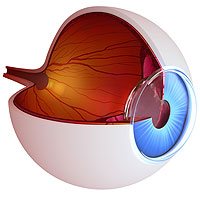
The retina is the light sensitive tissue at the back of the eye that acts as "The film of the camera". It converts light into nerve signals that are transmitted along the optic nerve to the vision centers in the brain. Problems with the retina are a common cause for failing vision, especially in the elderly.
The vitreo-retinal procedures include a variety of surgical and laser procedures performed to restore, preserve, and enhance vision. Vitreo-retinal procedures treat conditions such as age-related macular degeneration (AMD), diabetic retinopathy and diabetic vitreous hemorrhage, macular hole, retinal detachment, epiretinal membrane, CMV retinitis, and many other ophthalmic conditions.
Diabetes is one of the leading causes of blindness in the United States. Leaking and bleeding blood vessels on the retina can cause severe visual loss. Effective treatments include laser photocoagulation, and vitrectomy surgery. Regular Eye exams, good medical management of blood sugar and blood pressure, along with timely treatment can significantly reduce the risk of visual loss and blindness.
Eye Care Specialists has the latest diagnostic and therapeutic equipment to fight diabetic retinopathy including the availability of 4 lasers and 5 Diagnostic Imaging cameras for Fluorescein Angiography, used to identify the presence and location of abnormal blood vessels.
Macular Degeneration is the leading cause of legal blindness in the United States in persons over 60 years of age. While this condition rarely leads to total blindness, patients affected develop blurred, distorted, or patchy vision and may lose the ability to read, drive, or discern fine detail. Risk factors include nearsightedness, aging, heredity, and poor nutrition. Some macular degeneration cases may be treated with various lasers and surgical techniques.
Much like the film in a camera, the retina is responsible for creating the images one sees. When the retina detaches, it separates from the back wall of the eye and is removed from its blood supply and source of nutrition. If it remains detached, the retina will degenerate and lose its ability to function. Trauma, nearsightedness, proliferative diabetic retinopathy, and retinal tears are all causes of retinal detachment. Symptoms often include flashes of light, new onset of floaters, and loss of peripheral vision. If a retinal tear is discovered, detachment can usually be prevented using laser treatment. Fortunately, over 90% of retinal detachments can be repaired with a single procedure. The scleral buckle procedure, vitrectomy, and pneumatic retinoplexy are three different surgical approaches for treating this condition. If you are diagnosed with retinal detachment, the doctor will discuss which option best suits you.
Fluorescein Angiography is a diagnostic procedure that uses a special camera to take a series of pictures of the retina for careful study. Fluorescein is a water-soluble dye that is injected into a vein in the arm. As the dye passes through the retina's blood vessels, the camera flashes a blue light into the eye and takes multiple pictures of the retina. If there are abnormalities in the retina blood vessels, the dye will "leak" and show your physician the trouble spots in and around the retina. Diabetes and macular degeneration are two of the primary causes of these retina abnormalities. Fluorescein Angiography is an incredibly helpful tool in identifying the presence of damage done by such diseases. Call Eye Care Specialists for more information on how this diagnostic technique can help prevent this severe loss of vision.
Flashing lights and floaters at the corner of the eye are a fairly common occurrence for aging adults. Flashes and floaters can be benign and relatively harmless, or they can herald a significant pathological process in the back of the eye, which left unchecked can lead to loss of vision or major surgery. The only way to know if flashing light or floaters in your field of vision are benign or significant is to have a doctor dilate your eyes and examine them thoroughly.
The center of the eye is filled with a transparent gel like substance called the "vitreous". As we age, the "vitreous" undergoes certain chemical changes. This leads to the formation of deposits of protiens which form 'clumps and strings' floating in the gel. When light passes through the eye, the protien clumps throw a shadow on the retina producing a sensation of "floaters".
Floaters may be seen as strings, streaks, clouds, bugs, dots, dust, or spider webs. These objects appear to be in front of the eye, but they are really floating in this fluid, and at the same time, casting their shadows on the retina, the light sensing inner layer of the eye. The debris could be made up of blood, torn retinal tissue, inflammation, vitreous detachment, or could simply mean a normal aging change in the vitreous. Floaters could also signify retinal tears that might be threatening for vision loss.
The vitreous fluid degenerates during the middle age years, often forming minute debris within the eye. Floaters are also often noticed in people who are nearsighted (myopic), and those who have been operated on for cataract or Yag laser surgery. Floaters could interfere with reading, and can be quite bothersome. Even though there is no treatment or cure, they may slowly fade out over time. One possible remedy is to move the eyes up and down when a floater appears. The vitreous fluid may shift, thus permitting the floater to move out of the line of vision.
For the most part, floaters are usually nothing to worry about, being simply a result of the normal aging development. Usually it is recommended to see an Ophthalmologist within 24 hours of the onset of symptoms, as floaters could also denote a serious eye disease such as retinal detachment. The vitreous covers the retina surface, and sometimes the retina is torn when degenerating vitreous is pulled away. This leads to a small amount of bleeding, which may be interpreted as a new cluster of floaters. A torn retina is serious, and could possibly develop into a retinal detachment. Consequently, any new floaters that appear should be seen and evaluated by a doctor.
When the vitreous gel rubs against or pulls on the retina, it can produce the illusion of flashing lights. Flashes can be perceived as a sparkle, disco light, fireflies, lightning, fire works, or sparks. The same experience can happen after being hit in the eye, giving the illusion of seeing stars. All of these flashes are generated by any abnormal stimulus to the retina.
Light flashes can happen on and off for many weeks, or even some months. This is a common occurrence during the aging process, and it is generally not cause for concern. At times, however, a significant number of new floaters will appear, accompanied by light flashes, and partial sight loss of peripheral vision could occur. If this happens, it is important to see an ophthalmologist quickly in order to evaluate whether the cause is a torn retina or retina detachment.
Migraine flashes appear as zigzag, shimmering, or even colorful, lines that may move within the visual field. They usually last from five to thirty minutes and can occur in both eyes at once. They are most likely caused by a sudden spasm of blood vessels in the brain. These flashes are often associated with headache, nausea, or dizziness, but more often occur without such symptoms.
As in the case with floaters, an eye specialist should attend to any abrupt onset of an abundance of light flashes. The exam would involve close observation of the retina and vitreous fluid.
Floaters and Flashes are common visual symptoms that can be representative of normal aging changes in the eye or the onset of an eye disease that could lead to vision loss if left unattended. It is always prudent to consult an eye specialist when such vision changes occur.
A macular hole is almost always a spontaneous development that occurs predominantly in aging women. The development of a macular hole progresses through several stages, and with each progressive stage the vision may worsen. The cause of macular holes remains under investigation.
The diagnosis of macular holes in the early stages may be challenging or difficult, especially when there are concomitant disorders of the macula, such as age related macular degeneration. The ophthalmologist must rely on both the patient's vision and the subtlest signs of the disorder, which early on may include only a faint yellow spot or ring in the macula. Fluorescein angiography may sometimes be helpful in making the diagnosis as well. This diagnostic procedure is extremely safe and entails the intravenous or oral administration of fluorescein dye, followed by retinal photography.
The likelihood of visual improvement with macular hole surgery is about 70%. However, about 90% of macular holes can be successfully closed with surgery. For patients who develop a macular hole, the risk of developing a macular hole in the opposite eye is about 10% - 20%.
Surgical Procedure Repair of a macular hole begins with a vitrectomy procedure. The second aspect of the procedure typically involves membrane removal (removal of a membrane on the macula). Finally, in most cases, a gas bubble is placed with the vitreous cavity to help keep the macular hole closed while the retina heals. Unfortunately, patients must maintain face down positioning for about one to two weeks in order to keep the gas bubble over the macular hole.
If a clot (embolus) breaks free from the wall of a blood vessel leading up the neck or to the eye, it can lodge in the retinal arteries causing an obstruction of blood flow to the eye, and a loss of vision. In some cases, the clot will rapidly dislodge, and the vision will return. However, if the clot is large it may not dislodge, and the vision remains blacked-out. Usually this is painless, and the loss of vision is severe. If the blood flow to the retina is interrupted for more than 1 1/2 hours (approximately), the vision may not return even if the clot breaks free and the circulation is restored. This condition may indicate risk for cardiac disease and stroke.
If a person with this condition rapidly seeks the medical help from an ophthalmologist, sometimes it may be possible to dislodge the clot before permanent damage occurs, although often some amount of damage can occur immediately.
The retinal blood circulation is drained by a single vein, called the central retinal vein. If this vein becomes obstructed, various problems can occur in the eye, depending on the severity of the obstruction. A person with this condition will notice blurring of vision, dimming of vision, and possibly blind spots and floaters in the vision. It usually starts fairly suddenly, but the vision may worsen over a period of time (hours to days). Rarely does this happen in both eyes at the same time. The problem is usually caused by underlying vascular disease, and sometimes abnormal clotting or blood thickness. It is not caused by clots breaking off of arteries, like an artery obstruction is.
There is no effective treatment to reverse the blockage of the vein, except to treat any underlying medical condition (diabetes, hypertension, increased cholesterol, etc.), and hope that the vein opens back up on its own. About 1/3 of cases will completely resolve with little damage to the vision. About 1/3 stay the same with some loss of vision, and 1/3 of cases worsen and develop more severe loss of vision. The worst cases may need to be treated by a laser to prevent a dangerous form of glaucoma (neovascular glaucoma), but the laser treatment will not help the vision. The Retinal Doctors at Eye Care Specialists are involved in an FDA Trial of a new drug that may help treat this condition more effectively than in the past. (See article in the Latest News Section.)
Neovascularization is abnormal growth of blood vessels in areas of the eye including the inner back lining where images are processed (retina) and the clear front covering of the eyeball (cornea). Neovascularization in the retinal area can be associated with vision loss in diseases such as age-related macular degeneration and Diabetic Retinopathy. Corneal neovascularization can be linked to eye diseases causing inflammation. Corneal neovascularization also can result as a complication of wearing contact lenses.
Fundus Photography is a highly specialized form of medical imaging, which requires a customized camera that is mounted to a microscope with intricate lenses and mirrors. These high-powered lenses are designed so the photographer can visualize the back of the eye by focusing light through the cornea, pupil and lens. These pictures are necessary to document the health of the optic nerve, vitreous, macula, retina and its blood vessels. The photographs are used for comparison, documentation, and sometimes to diagnose certain eye conditions.
Before beginning, the pupil is dilated with drops. Otherwise, it would automatically constrict from the bright light of the camera flash. The patient is asked to stare at a fixation device so the eyes are still. While the photographer is taking the pictures, the patient will see a series of bright flashes. The entire process usually takes approximately five to ten minutes.
Optical coherence tomography is an optically-based test that is able to demonstrate retinal anatomy non-invasively and in seconds at a microscopic level. Because even subtle areas of retinal anatomic changes can be seen, this test has significantly improved our diagnostic accuracy and our understanding of retinal diseases.

Normal OCT. The retina has ten layers and should show a “dip” in the middle of the retina. Clinically this is the macula and is the area responsible for central vision.
Dry macular degeneration appears realtively normal on OCT testing. Drusen can be seen as subretinal deposits, and geographic atrophy can be seen as retinal thinning.
Wet macular degeneration is characterized by subretinal tissue and fluid on OCT testing. The complex of vessels can be seen as a subretinal mass with associated subretinal and intraretinal fluid. Response to treaments can also be followed. Successful treatment can show resolution or reduction in fluid.
WHAT IS LUCENTIS™
LUCENTIS™ (ranibizumab injection) is a prescription medicine for the treatment of patients with wet age-related macular degeneration (AMD).
LUCENTIS™ is a breakthrough treatment for wet AMD that can do more than just help you maintain your vision. With LUCENTIS™, people with wet AMD may see their vision improve or keep the vision they have.
LUCENTIS™ is an FDA-approved treatment specifically developed for the treatment of wet AMD.
Of patients in key clinical studies taking LUCENTIS™ monthly...
LUCENTIS™ is for prescription use only. Individual results with LUCENTIS™ may vary.
LUCENTIS™—shown to improve vision or keep the vision you have
In clinical studies, some people taking LUCENTIS™ (ranibizumab injection) saw their vision get better—up close and far away. In fact, up to 40% of LUCENTIS™ patients achieved 20/40 vision after 1 year of monthly treatments. That's just another part of the exciting possibility with LUCENTIS™. With LUCENTIS™, even the simple things in life can be easier and more enjoyable.
Of those taking LUCENTIS™ monthly...
Wet AMD occurs when abnormal blood vessels grow in the back of the eye. As the blood vessels grow, they can leak blood and fluid, which damage the macula. The macula—which is the center of your retina—plays a key role in your central vision. LUCENTIS™ (ranibizumab injection) is designed to block abnormal blood vessel growth and leakage.
Along with the abnormal growth blood vessels, certain proteins are thought to play a big part in causing wet AMD. LUCENTIS™ is a treatment that targets these proteins—preventing them from causing more damage and possibly even reversing their effects.
Understanding wet AMD and LUCENTIS™
To visualize this, imagine the roots of a tree growing and spreading until they actually uproot a sidewalk. Then imagine rainwater seeping up throughout the cracks. These abnormal blood vessels (the "roots") tend to be very fragile. They often grow, and leak or bleed, causing scarring of the macula. This damage to the macula results in rapid central vision loss. LUCENTIS™ stops the fragile roots from growing and spreading.
LUCENTIS™ (ranibizumab injection) is a prescription medicine for the treatment of patients with wet age-related macular degeneration (AMD).
Important Safety Information
Like any prescription medication, LUCENTIS™ is not for everyone. You should not use LUCENTIS™ if you have an infection in or around the eye.
Like other injections given into the eye, serious eye infection (endophthalmitis) and detached retina have occurred with LUCENTIS™. Increases in eye pressure have been seen within 1 hour of an injection. Your eye doctor will monitor your eye pressure and eye health during the week after every injection. If your eye becomes red, sensitive to light, painful, or has a change in vision, you should seek immediate care from your eye doctor.
Although uncommon, conditions with certain blood clots (arterial thromboembolic events) may occur.
Serious side effects related to the injection procedure were rare. These included serious eye infection, detached retina, and cataract. Other uncommon serious side effects included inflammation inside the eye and increased eye pressure.
The most common eye-related side effects were red eye, eye pain, small specks in vision, the feeling that something is in your eye, and increased tears. The most common non–eye-related side effects were high blood pressure, nose and throat infection, and headache.
Know all you can about AMD
Caring for someone with AMD can be challenging. Staying informed can help. Do your homework and find out as much as you can about AMD. Since AMD is a progressive disease, it's important to treat it as early as possible. Without treatment, it can cause central vision loss. That's why it's important for you to stay informed and stay involved. And be sure to attend eye doctor appointments for routine eye exams and ask him or her questions.
Take notice
Have you noticed that your friend or loved one isn't reading the newspaper as often as they used to? Are they asking for more light when they read a book? Are they driving less? These may be a few signs that they are having trouble with their eyesight. It may also mean that these are early symptoms of AMD. So if you have noticed any change in your friend or loved one's vision, make an appointment with an ophthalmologist or retina specialist.
Helping out
If someone close to you has or may have macular degeneration, there are some things you can do. First, ask what would be helpful for you to do for them. You may find that there are specific tasks that they need you to do (such as writing out checks, or going food shopping). Arrange for them to receive large-print editions of their newspaper, phone book, or bank statements.
Often times, people with low vision don't want to be treated as though they are impaired. And they may try to live their life without any help. So it is important to be patient. You may want to think about their emotional needs, too. Some people may be hesitant to share feelings of depression or helplessness. Be ready to talk and be supportive.
Support for family and friends
Support is available for the family, friends, and caregivers of people with AMD. Ask an ophthalmologist or retina specialist for more details on support groups. Or, contact a low-vision organization in your area to learn more.
Over time, after getting regular treatments of LUCENTIS, about 95% of patients noticed that their vision stayed the same and about 40% of patients noticed an improvement in their vision. Reading and watching TV are usually less troublesome. Blurry Vision and wavy lines should also lessen.
There is no cure for AMD. But it can become a manageable condition by treating it regularly with LUCENTIS. For additional information on LUCENTIS, you may click here www.lucentis.com
Dr. Kruger, Dr. McLaughlin, and Dr. Savage specialize in the treatment of macular degeneration.